The Intersection of Purpose, Skill, and Value
Ikigai is a Japanese concept that explores the idea of purpose. The word roughly translates to “a reason for being.” It describes the place where personal passion, natural ability, meaningful contribution, and economic value intersect. The framework became widely known through the work of Héctor García and Francesc Miralles, who studied communities in Japan known for longevity and strong life satisfaction.
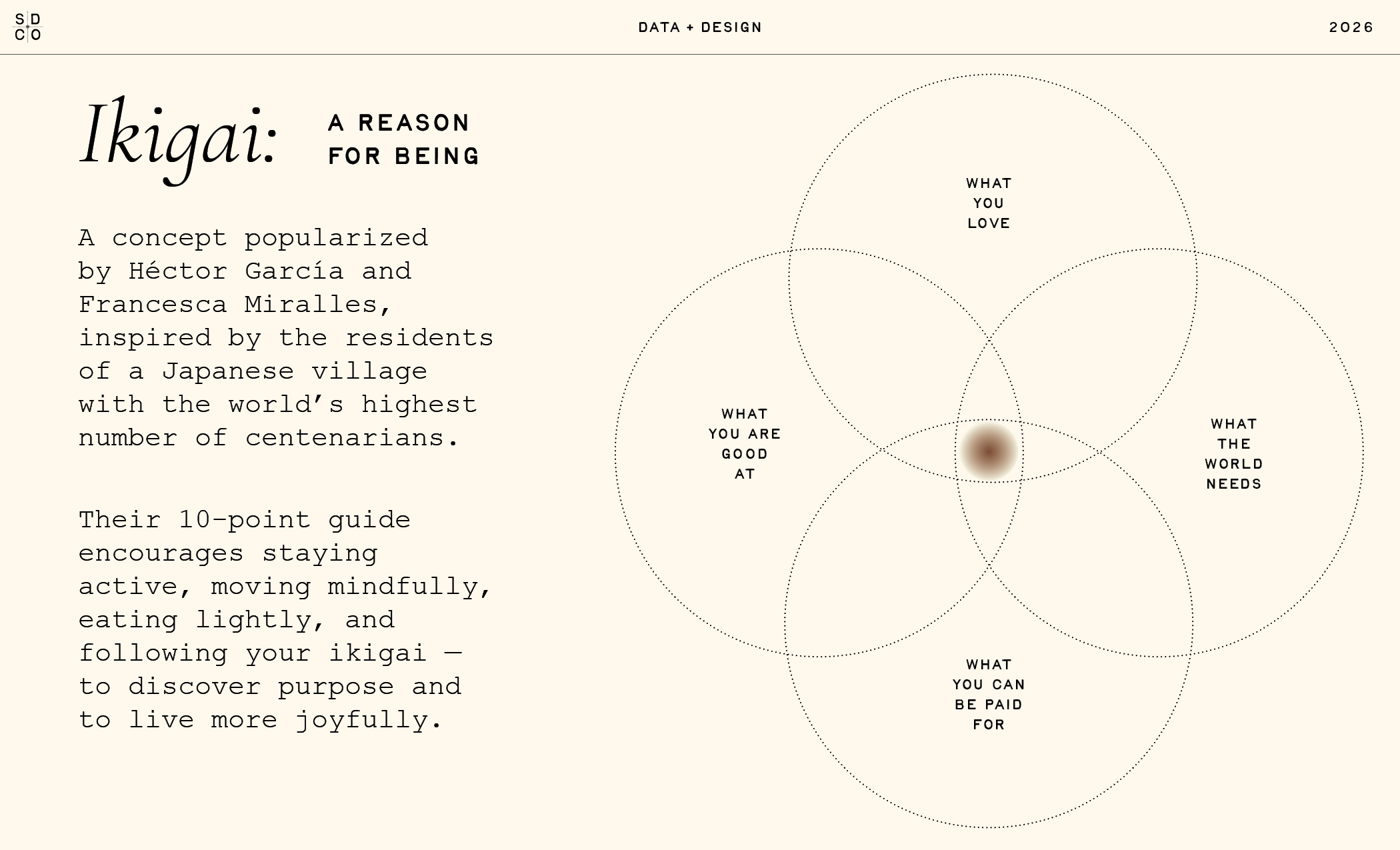
In modern discussions, Ikigai is often visualized as a four circle diagram representing four essential questions.
The Four Dimensions of Ikigai
Ikigai sits at the intersection of four overlapping areas.
What You Love
Your passions and interests. These are the activities that energize you and hold your curiosity. They are often the work you naturally gravitate toward, even when no one is asking for it.
What You Are Good At
Your skills and abilities. These are the strengths you have developed through practice, education, and experience. Over time, skill transforms interest into expertise.
What the World Needs
Your contribution. This dimension reflects the ways your work can help others, solve problems, or create meaningful value in the world.
What You Can Be Paid For
Your economic sustainability. Purpose alone is not enough for a lasting career or business. The work must also be economically viable and valued by the marketplace.
Where the Circles Meet
Ikigai emerges where all four dimensions overlap. When passion, skill, contribution, and economic value align, work begins to feel both meaningful and sustainable. This balance is why Ikigai is often used as a framework for thinking about career direction, entrepreneurship, and creative practice.
Ikigai and Creative Work
For designers, entrepreneurs, and creative professionals, Ikigai offers a useful lens for thinking about alignment. Many businesses begin with passion or talent, but struggle when one of the other dimensions is missing. A creative practice may be fulfilling but difficult to sustain financially. A profitable service may feel disconnected from personal interests or values. The Ikigai framework encourages a broader perspective.
Instead of focusing on only one dimension, it asks how all four can work together.
Why the Ikigai Model Resonates
The power of Ikigai is its simplicity. It reminds us that purpose is rarely the result of a single decision. It emerges at the intersection of multiple forces.
Passion provides energy.
Skill provides capability.
Contribution provides meaning.
Economic value provides sustainability.
When these elements align, work becomes more than a task. It becomes a direction.
A Framework for Reflection
Ikigai is not a formula to be solved once. It is a framework for reflection that evolves as people grow, develop new skills, and explore new opportunities. For many creative professionals and founders, understanding this intersection can provide clarity about the kind of work they want to build and the kind of impact they hope to have.