A Theory of Human Motivation
Understanding Human Motivation and Design Psychology
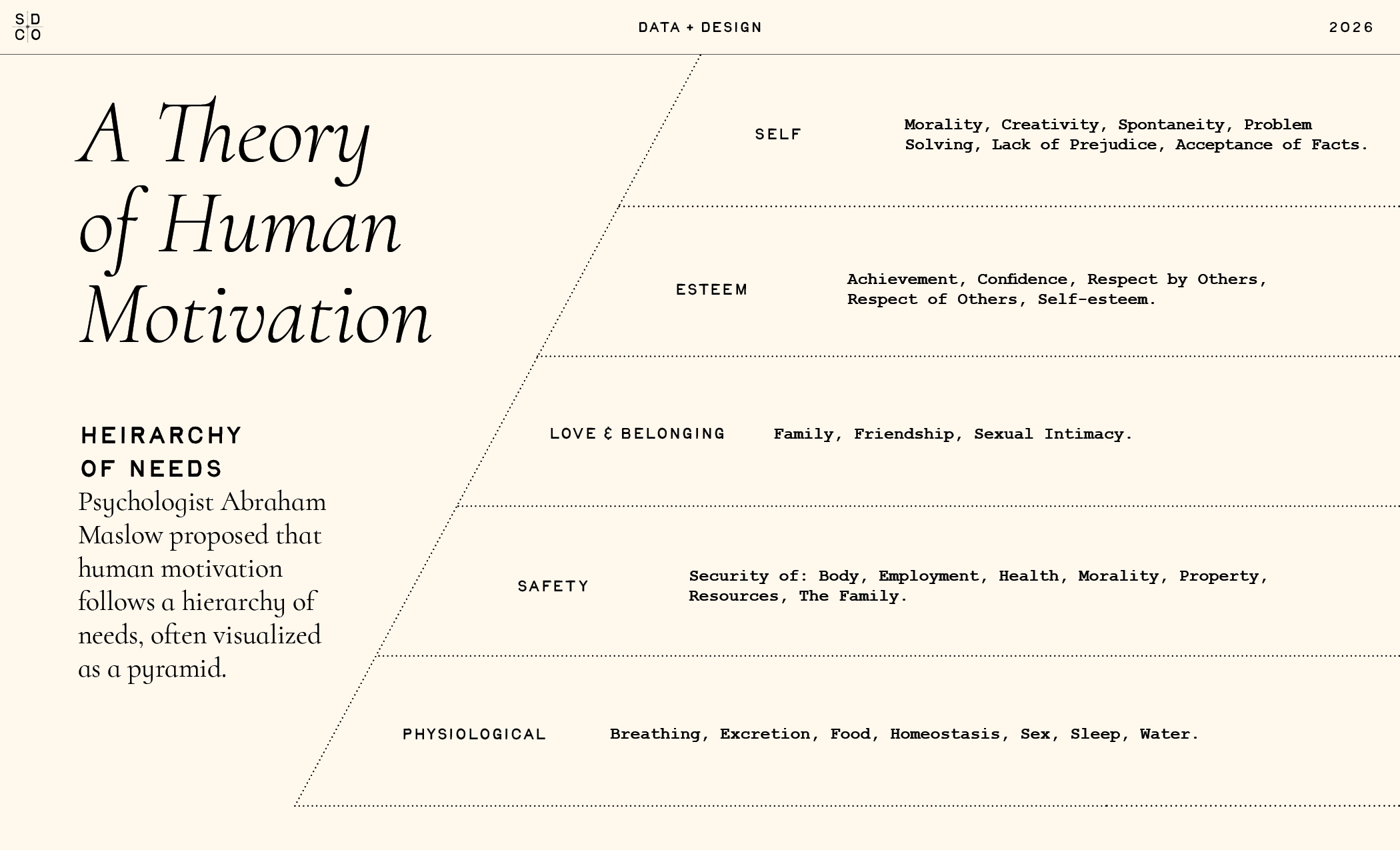
Maslow’s Hierarchy of Needs is a psychological framework that explains how human motivation develops.
The model was proposed by Abraham Maslow in 1943. Maslow suggested that human needs are structured in layers, often visualized as a pyramid. Basic survival needs form the foundation, while higher levels relate to belonging, personal growth, and fulfillment. The idea is simple. Before people can focus on higher aspirations, their more fundamental needs must first be met.
Although originally developed in psychology, this framework has become widely used in fields such as education, business, marketing, and design.
The Five Levels of Human Needs
Maslow organized human motivation into five primary layers.
Physiological Needs
The most fundamental needs for survival. These include air, water, food, rest, and shelter. Without these basic requirements, human attention remains focused on survival rather than higher pursuits.
Safety Needs
The desire for stability and protection. Once survival needs are met, people seek security. This includes personal safety, financial stability, predictable environments, and reliable systems.
Love and Belonging
The need for connection. Humans are social beings. Friendship, family relationships, community, and social belonging all support emotional well being.
Esteem
The need for respect and recognition. Esteem includes both internal confidence and external acknowledgment. People seek a sense of accomplishment, competence, and appreciation from others.
Self Actualization
The pursuit of personal fulfillment. At the highest level, individuals focus on growth, creativity, and realizing their full potential. This is where people pursue meaningful goals, innovation, and personal expression.
Why This Framework Matters in Design
Design is ultimately about people. Every interface, brand, or experience interacts with human expectations and motivations. Understanding psychological frameworks like Maslow’s helps designers create environments that feel intuitive, trustworthy, and engaging.
For example:
Clear navigation and predictable layouts support safety and stability
Community driven brands foster belonging
Strong visual identity and thoughtful storytelling support esteem and recognition
When design aligns with human needs, people feel more comfortable engaging with a brand.
Maslow’s Hierarchy and Brand Experience
Brands often operate across multiple levels of the hierarchy. At a foundational level, a website must feel reliable and functional. Users need to trust that information is accurate, systems work correctly, and interactions are safe. Once that foundation is established, design can support deeper emotional connections. Storytelling, brand personality, and community engagement help audiences feel aligned with a brand’s values and identity.
Over time, strong brands become associated with aspiration and meaning, connecting to the higher levels of the hierarchy.
A Framework for Understanding Human Behavior
Maslow’s Hierarchy remains influential because it provides a simple way to understand complex human motivations. While the model is not rigid or universal, it offers a useful lens for thinking about how people prioritize needs and make decisions. For designers and entrepreneurs, the lesson is straightforward. When design acknowledges human psychology, it becomes more thoughtful, more intuitive, and more effective.