The Iron Triangle
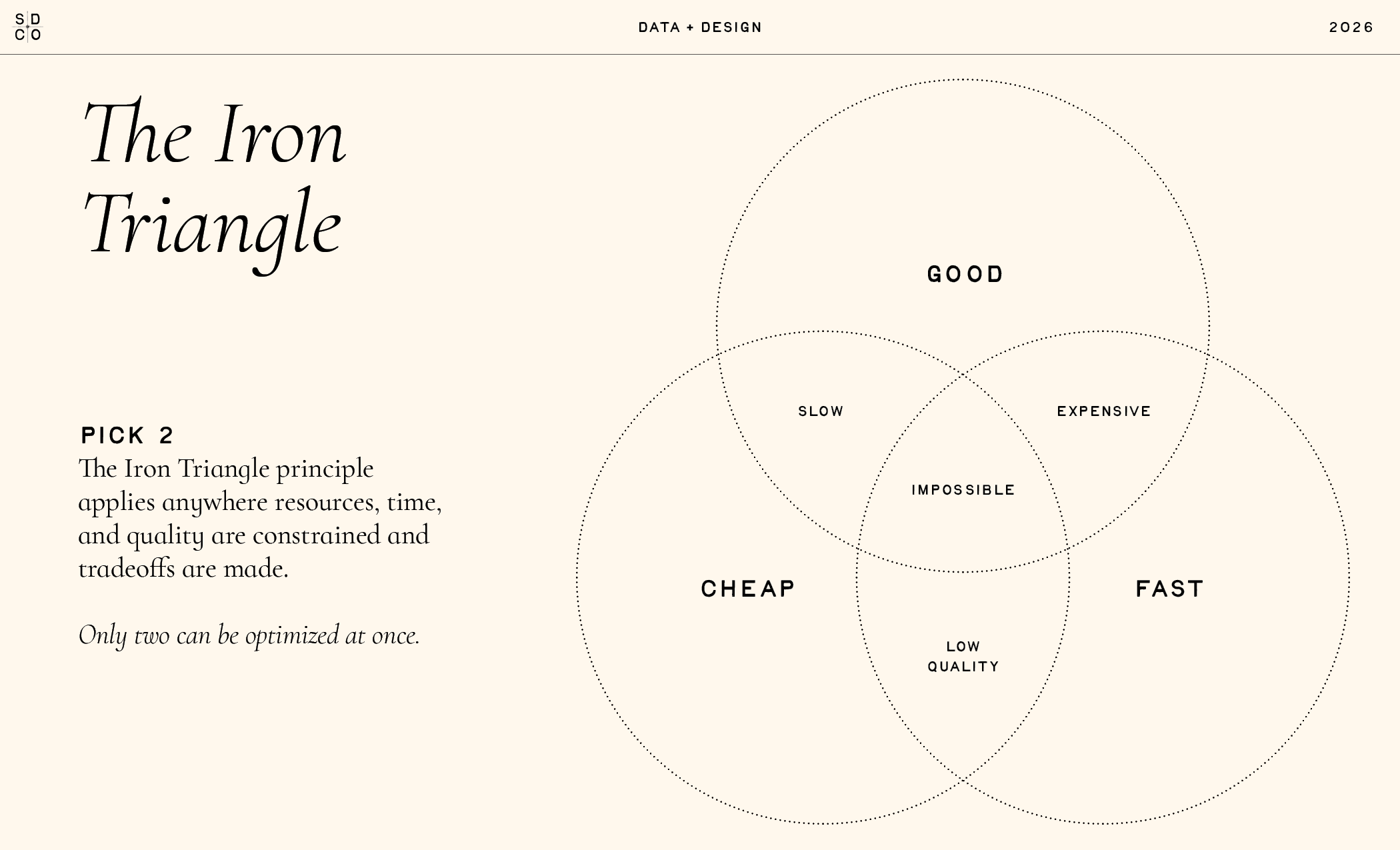
Understanding the Balance Between Time, Cost, and Quality
The Iron Triangle is a framework used to explain the relationship between three key constraints in any project: time, cost, and quality.
The concept is widely used in project management and product development to illustrate a simple truth. When resources are limited, improving one factor usually requires adjusting the others.
In its simplest form, the model suggests that projects must balance three forces:
Speed
Affordability
Quality
Most projects can realistically optimize two of these at once, but rarely all three.
The Three Constraints
The Iron Triangle highlights the tradeoffs that shape nearly every project.
Time
How quickly the work must be completed. When deadlines are short, teams often need more resources or simplified outcomes to meet the timeline.
Cost
The budget available for the work. Limited budgets require careful prioritization. Reducing cost often means extending timelines or reducing complexity.
Quality
The depth, refinement, or craftsmanship of the outcome. High quality work typically requires more time, more expertise, or both.
The Reality of Tradeoffs
The Iron Triangle is often summarized with a familiar phrase:
Fast, cheap, or good. Pick two.
While the phrase is simplified, the principle highlights an important reality. Projects operate within constraints, and understanding those constraints leads to better decision making.
For example:
Fast + high quality = a higher budget
Affordable + high quality = more time
and Fast + affordable = limits the level of refinement possible
Recognizing these relationships helps teams set realistic expectations and prioritize what matters most.
Why This Framework Matters in Design
Design projects operate within the same constraints as any other type of work. Brand identity systems, website builds, and creative projects all require balancing time, budget, and depth of exploration. When these factors are understood early, the process becomes clearer for both designers and clients.
Instead of frustration or confusion, decisions can be made intentionally.
A Tool for Clearer Collaboration
The Iron Triangle is useful because it encourages transparency. It reminds teams that every project decision has implications for time, cost, or quality. When those tradeoffs are discussed openly, expectations become clearer and outcomes become stronger. For designers, entrepreneurs, and collaborators, understanding this balance helps create more realistic timelines, healthier working relationships, and better finished work.